from $51.93 Holbox Bioluminescence Tours: Kayak, Swim, and the Nights They Run
Paddle past the last lights of the island and the water breaks into green sparks around your hands. See which Holbox bioluminescence tour fits which night, all of them with free cancellation.
Updated August 2026
- From $52 per person
- 4.6 from 300 reviews on the most-booked kayak trip
- Free cancellation 24 hours ahead
Quick answer
A Holbox bioluminescence tour costs about $52 per person, runs after dark on nights when the moon is down or thin, and never operates on a full moon. Guides confirm your start time the day before, because the lunar calendar decides it: departures fall anywhere between roughly 8pm and 4am. The glow is brightest from May to September, when the operators rate it at 70% to 100% intensity, and drops to 30% to 80% the rest of the year. You can also stand in the shallows at Punta Cocos for nothing, though the bright water sits out on the sandbars, and only a kayak gets you there.
Key takeaways
- Cheapest and most reviewed: the Eco Adventure kayak trip at $52, rated 4.6 from 300 reviews, with a 4x4 pickup and about 45 minutes on the sandbars
- No kayak, no paddling: the wetsuit-and-mask swim at $54, run by the guide an independent reviewer named the best on the island
- Every listing cancels free up to 24 hours ahead and charges nothing today, which matters when the sea decides the schedule
- Nothing runs on a full moon. Check the month-by-month intensity before you fix your dates, not after
- Doing it free: walk or take a golf cart west to Punta Cocos, about a mile from town. Expect less than the boats see
- Bring biodegradable repellent only. Ordinary repellent and sunscreen wash off into the water the plankton live in
- Minimum ages differ: 10 on one kayak trip, 18 to book the wetsuit swim, so check before you book for a family
The Three Bookable Holbox Bioluminescence Tours
Three listings, three genuinely different nights out. One paddles to the sandbars off Punta Mosquito, one paddles from its own beach south of town, and one skips the kayak and puts you in a wetsuit.
from $51.93
from $51.93 Guided Night Kayak to the Glowing Sandbank
Check Availability
from $53.66 Wetsuit Bioluminescence Swim with a SECTUR Guide
Check AvailabilityKayak or Wetsuit: What Separates the Three
The prices sit within two dollars of each other, so price is not the deciding row. Read the format, the age limit and where each one actually goes.
| Eco Adventure | VIP Holbox | Book | Alejandro Flores | |
|---|---|---|---|---|
| Format | Kayak, then walk and swim | Kayak, then swim | Guided swim, no kayak | |
| Price per person | $52 | $52 | $54 | |
| Duration | 2 hours | 1.5 hours | 1.5 hours | |
| Where it goes | Sandbars off Punta Mosquito | Sandbank off their own beach | Shallow water near town | |
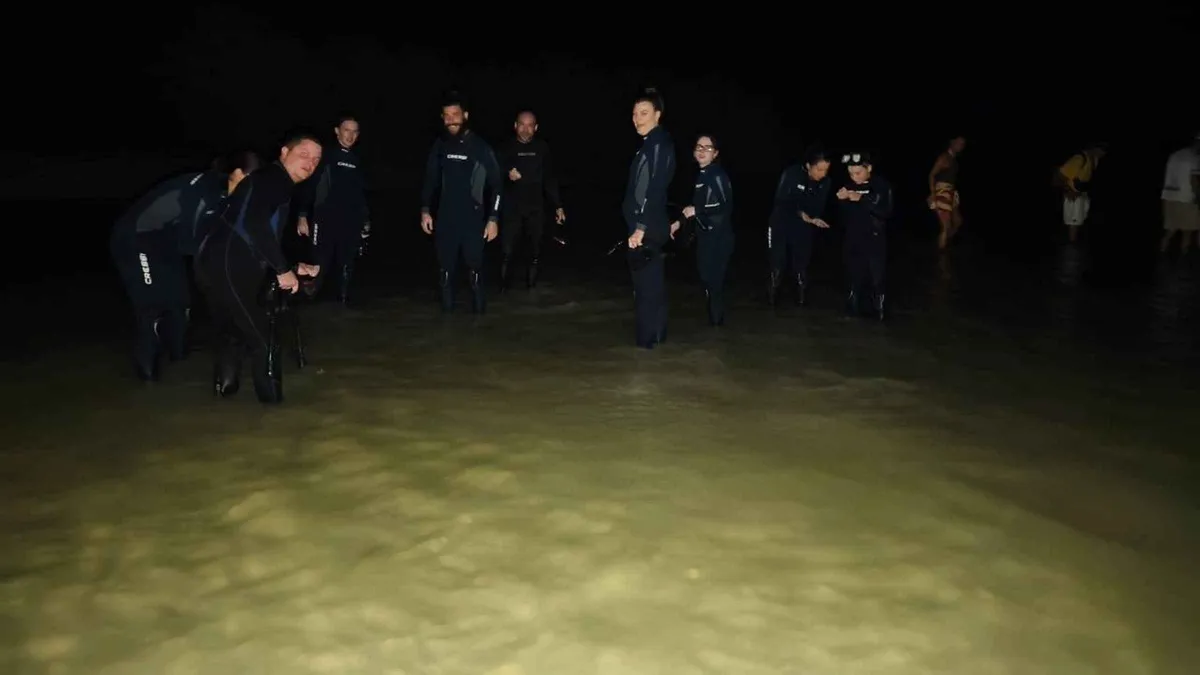
| What you wear | Your swimwear and a life jacket | Your swimwear | Long wetsuit, water shoes, snorkel mask | |
| Paddling | 15 to 20 minutes each way | 20 minutes each way | None | |
| Transfer | 4x4 to Las Nubes and back | Pickup in some areas | Private buggy both ways | |
| Rating | 4.6 from 300 reviews | 4.3 from 147 reviews | 4.6 from 6 reviews | |
| Minimum age | 2 years | 10 years | 18 to book | |
| Languages | English, Spanish | English, Spanish | English, Spanish, Italian |
The Moon Sets the Date. Everything Else Follows.
Why No Operator Runs on a Full Moon
The plankton glow is faint. A single dinoflagellate produces a flash you could cover with a fingernail, and what you see in the water is thousands of them firing at once as your hand pushes past. Put a full moon over that and the surface reflects enough light to erase it.
So the operators do not try. Alejandro Flores Castañeda states it in the booking terms: the activity does not take place on full moon nights. The others schedule around the same calendar without spelling it out. If the only free evening on your Holbox itinerary lands on a full moon, you will not be paddling that night, and no amount of paying more fixes it.
The useful version of this rule: look up the new moon date for your month before you lock your ferry dates. The week either side of it is the good week.
- New moon and the three or four nights either side: darkest sky, tours run at civilised hours
- First and last quarter: still fine, but the window shifts to after the moon sets
- Two or three nights around the full moon: cancelled, or moved to 4am when the moon finally drops
Why Your Start Time Arrives the Day Before
Nobody publishes a fixed departure time, and the reason is the same moon. Guides work out when the sky goes properly dark on your specific night, then send the time the evening before.
The range is wider than most visitors expect. A writer at wherenext.blog booked her night during a full moon and was collected at 4am, because the gap between moonset and sunrise was the only dark hour available. A traveller on the Eco Adventure trip in June 2026 got back to her hotel at 4:15am. Other weeks, groups leave at 8pm and are back before midnight.
Plan the next morning around that. If you have a ferry to catch, tell the operator when you book. The guide in the wherenext.blog account drove his guests to the ferry port on his own ATV so they would make a 6am boat, which is the kind of thing a small island operator does and a coach company does not.
| What you are told | When | What it means for you |
|---|---|---|
| The date | At booking | Pick the dark half of the lunar month |
| The start time | The evening before | Keep the following morning loose |
| Weather cancellation | Same day | Full refund, paid back immediately |
What Happens If the Sea Says No
Wind kills these trips more often than rain does. A chop on the water makes the paddle out unpleasant and scatters the plankton bloom, and the guides call it off rather than sell you a bad night.
Every one of the three listings refunds in full when that happens, and all three let you cancel free up to 24 hours before departure without giving a reason. None of them takes payment at booking. Holding two possible dates costs nothing, and on an island where the tour depends on the sky, holding two dates is the sensible move.
The Lunar Month, Night by Night
One cycle of the moon, from new to new. The dark cards are the nights operators want you on the water; the pale ones are the nights the moon washes the glow out.
- New moon Night 1No moon at all. Tours leave early, often around 8pm to 9pm.
- Waxing crescent Nights 2-6A thin moon that sets soon after sunset. The whole night is dark.
- First quarter Nights 7-9Half-lit moon down around midnight. Departures move later.
- Waxing gibbous Nights 10-13Bright until the small hours. Trips run at 2am or not at all.
- Full moon Nights 14-16Nothing runs. The reflected light erases the plankton entirely.
- Waning gibbous Nights 17-20Moon rises late but stays up. A short dark window before moonrise.
- Last quarter Nights 21-23Dark from sunset until around midnight. Early starts return.
- Waning crescent Nights 24-29Dark evenings again, and the sandbars at their blackest.
- Darkest nights, tours run early
- Dark window after moonset
- Late start, or cancelled
- No departures
Night numbers count from the new moon and shift by a day or two each cycle. The operators do the arithmetic for you and send the time the evening before.
How Bright It Gets, Month by Month
The bars are the intensity Eco Adventure Holbox quotes for its own trips: 70% to 100% from May to September, 30% to 80% across the rest of the year. The figure under each month is the average sea temperature you will be swimming in.
- 45% Jan 25°C
- 45% Feb 25°C
- 50% Mar 26°C
- 60% Apr 27°C
- 80% May 28°C
- 90% Jun 29°C
- 95% Jul 30°C
- 95% Aug 30°C
- 85% Sep 30°C
- 65% Oct 29°C
- 55% Nov 27°C
- 45% Dec 26°C
- May to September: warm water, dense blooms, the operators' 70% to 100% band
- October to April: still there most nights, rated 30% to 80%, and colder to stand in
There is no closed season. Tours run all year, and the phase of the moon on your chosen night matters more than the month printed on your ticket.
What You Actually See, and What You Do Not

It Is Sparks, Not a Glowing Blue Wave
Search for photographs of this and you get long-exposure shots of a shoreline lit up in electric blue, surf glowing like a neon strip. Holbox does not look like that, and going out expecting it is the fastest way to be disappointed by something remarkable.
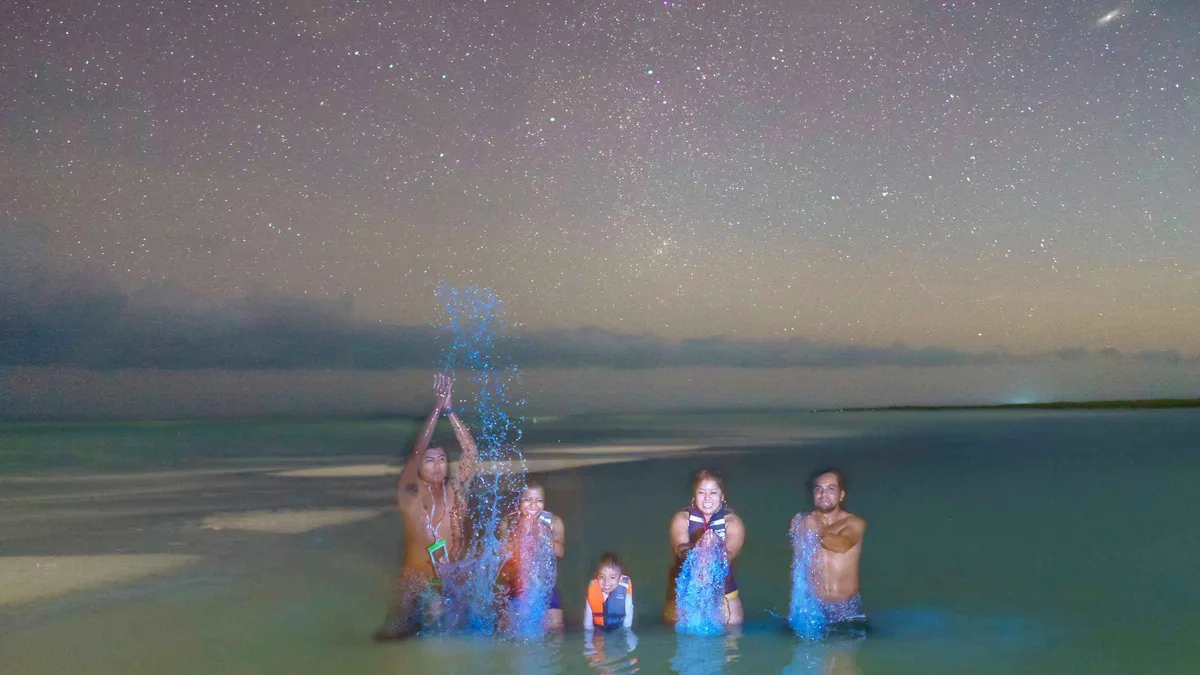
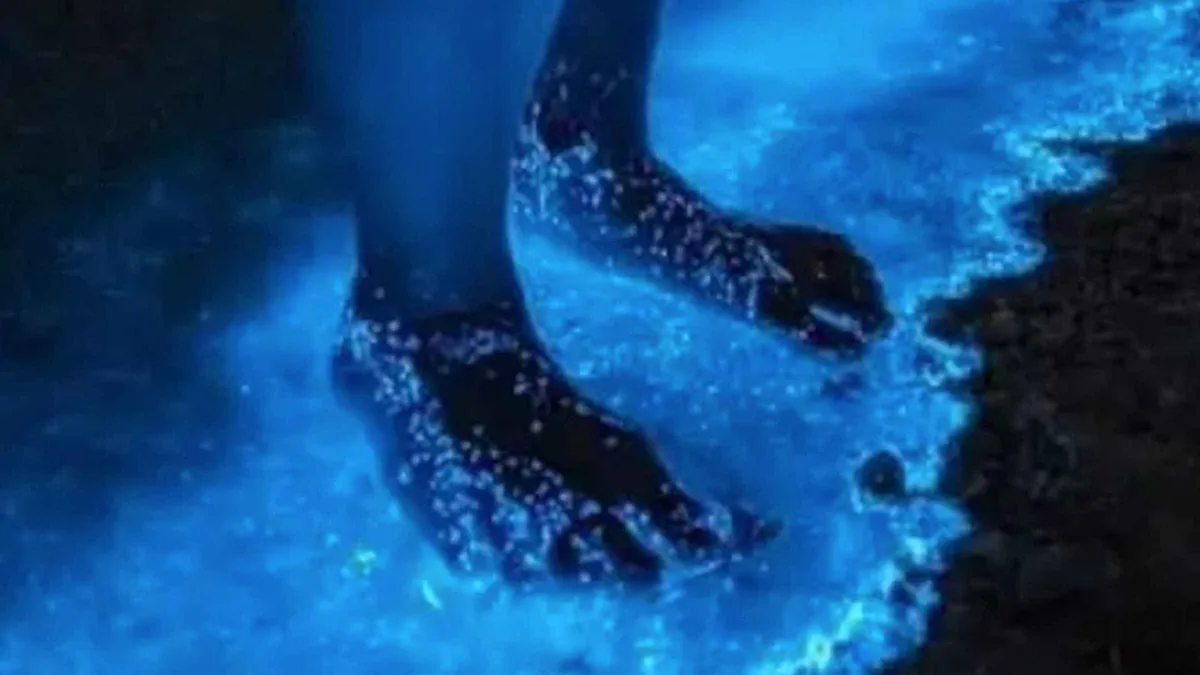
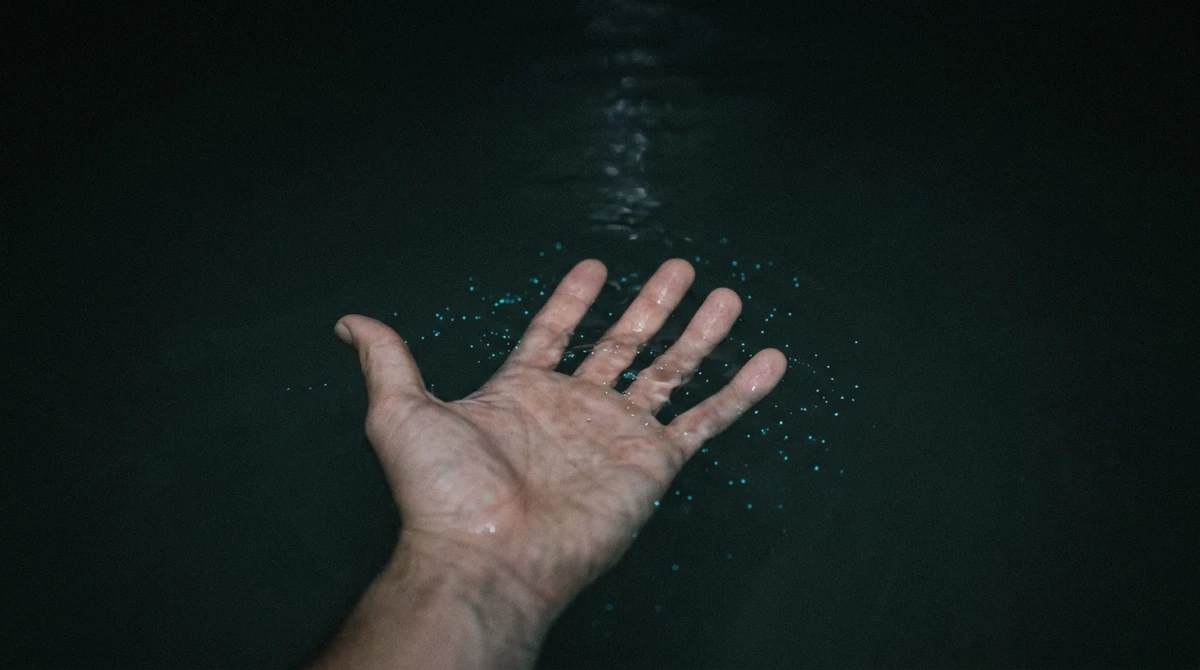
Here the organisms behave as individual points of light. Push your hand through the water and a swarm of pinpricks lights up around your fingers and fades in a second. Walk on the sandbar and each footprint fills with blue-green dots. Drag a piece of cloth through the shallows and it glitters. The wherenext.blog account puts it well: these creatures capture light and glow like individual stars.
The colour is not fixed either. Eco Adventure's guides tell groups to expect green, white or blue, and say plainly that which one turns up is unpredictable. So is the density, which depends on the plankton count, water temperature and the current running that night.
Your Phone Will Not Capture It
Flash photography is banned on all three tours, and not for a fussy reason. A flash blinds everyone's night vision for the next few minutes and ruins the thing the group came for.
Without a flash, a phone camera has no chance. The light level is far below what a small sensor can gather, and what you get is a black rectangle. Guides on the kayak trip supply a 10-litre drybag per couple and one reviewer's advice was to bring nothing but something to take photos with and cash for tips. Bring the phone if you like, then accept that this is an experience you will describe rather than post.
Specialist astrophotography kit on a tripod can do it. Nobody is setting up a tripod on a sandbar in the dark from a kayak.
The Stars Are Half of Why People Rate It Five
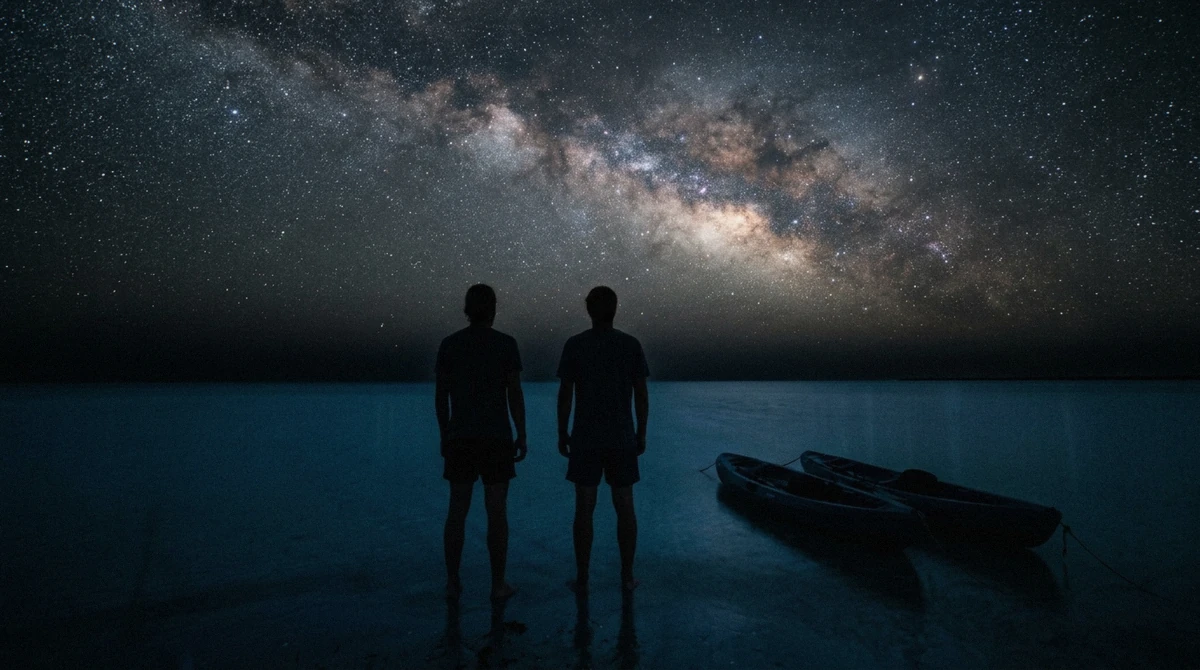
Read the reviews and the sky comes up as often as the water. Holbox has no street lighting, so once the kayaks clear the last houses the Milky Way is plainly visible and shooting stars are ordinary rather than remarkable.
All three operators lean into this. Guides name constellations, clusters and planets while the group floats. One traveller from Hungary wrote in July 2026 that the guide told them about the stars, marine life and the rhythm of the tides, and that the whole thing became more than a tour. A Swiss visitor said the same about the wetsuit trip in April 2026: a lot of laughing, and a lot learned about plankton and constellations.
On a night when the plankton underperform, the sky is what saves the trip. That is worth knowing before you book, because it means a mediocre bloom does not equal a wasted night.
Seeing the Holbox Bioluminescence Without a Tour
Punta Cocos, Free, About a Mile West of Town
You do not need to pay anyone. Punta Cocos sits on the western tip of the island, roughly one mile from the centre of town, which is a 30-minute walk along the beach or about 10 minutes in a golf cart taxi. There is no gate and no ticket. Walk into the shallows, swirl your feet, and on a good dark night the water answers.
What you give up is brightness. The town side of the island throws light onto the water, the sand near the point gets churned by other visitors doing the same thing, and the dense plankton concentrations sit offshore on the sandbars rather than at your ankles. Reviewers who did both describe the free version as a taste and the paddle out as the real thing.
We wrote up the walk, the sunset timing and the mosquito problem in a separate guide to the beach at Punta Cocos. Bring a torch and use it sparingly. Holbox has no street lights, phone reception is patchy, and the walk back into town is genuinely dark.
- Go on a new-moon night, the same rule the operators follow
- Take a golf cart taxi if you are nervous about the walk back after midnight
- Leave valuables at your hotel and carry cash only
- Skip sunscreen and standard repellent before you go in the water
- Give your eyes fifteen minutes to adjust before deciding there is nothing there
Punta Mosquito Is Closed, and That Confuses People
Half the guides online send you to Punta Mosquito on the eastern tip. The point itself is a protected area and access is completely prohibited, a fact Eco Adventure Holbox states in its own tour description before explaining that the trip goes to the sandbars nearby instead.
So the destination that shows up in every search result is one you cannot legally stand on, and the water around it is reachable by kayak on an organised trip. That single detail is the honest argument for paying the $52: not that the free option fails, but that the good water is out where a guided kayak takes you.
If you want the middle path, do both. Walk to Punta Cocos on your first dark night for nothing, and if it delivers, book the kayak trip for the one after.
Where the Glow Is, and How Far It Is
Holbox town sits in the middle of the island's southern shore. Punta Cocos lies about a mile west, walkable in half an hour. The sandbars the kayaks reach lie off the eastern end near Punta Mosquito, roughly 2.5 km from the centre, and the point itself is a closed reserve.
What to Bring, and What Gets Turned Away
Pulled from the three operators' own lists. The repellent rule is the one people get wrong.
Wear it, bring it
Swimwear under your clothes, a full change for afterwards, a towel and water shoes. The sandbars have shell fragments and you will be walking on them in the dark.
Biodegradable repellent only
Mosquitoes on a mangrove island at night are not a rumour. Standard repellent and sunscreen wash off into the same water the plankton live in, so buy the biodegradable version in town before you go.
No flash, no drones
Flash photography is banned on all three tours, along with drones. Both wreck the darkness the whole group is paying for, and neither will produce a usable image anyway.
Cash, and not much else
Tips are optional and expected, ATMs on the island run dry, and mosquito repellent and any taxi stop during pickup are on you. Large bags, coolers and alcohol are refused.
Age limits differ
The Eco Adventure kayak takes children from 2 with an adult, the VIP trip sets the floor at 10, and the wetsuit swim requires the booker to be 18. None suits pregnancy, heart or back problems.
Swimming ability
You stand rather than swim on the sandbars, in water around a metre deep, and life jackets come with the kayaks. The wetsuit on the Alejandro Flores trip adds buoyancy for anyone uneasy in the sea.
How to Pick Between Them
Most reviews, longest night
Eco Adventure has 300 reviews against 147 and 6, runs two hours rather than ninety minutes, and gives you about 45 minutes on the sandbars. It is the default answer for most people.
If you would rather not paddle
Alejandro Flores Castañeda's trip has no kayak at all. Wetsuit, water shoes and a snorkel mask, a briefing on the beach, then an hour and a half swimming at about a metre depth.
Travelling with a small child
Only the Eco Adventure kayak accepts children under 10, from age 2 with an adult. The other two set their floors at 10 and 18.
Cold water, thin blood
Sea temperatures sit near 25°C in January and 30°C in August. In the winter months the long wetsuit on the third trip is the difference between staying in and getting out early.
The independent verdict
The travel writer at wherenext.blog picked her operator on Viator and TripAdvisor ratings alone, went with Alejandro Flores Castañeda, and named him the best on the island. She had no affiliate relationship at the time.
Booking two nights costs nothing
None of the three charges at booking and all cancel free 24 hours out. On an island where wind and moon decide the evening, holding a backup date is free insurance.
What People Wrote After Going Out
Seeing the stars, the Milky Way, and so many shooting stars before heading out on the water was already unforgettable. Then, once we started kayaking, every paddle stroke made the water glow with bioluminescence. We also loved stopping at the sandbank, where we could experience the glowing water up close in complete darkness.
Isa and Juan were knowledgeable and friendly. They provide a dry bag for your personal items. It is very dark, so if you struggle with your vision at night, this may not be the activity for you. Again, it is completely dark, you can't see in the water or really very far ahead of you. Definitely a trust the process type of experience. We got back to our hotel around 0415.
Our guide seemed very disengaged, tired and short tempered. We kayaked a very short way, stopped at a sandbar, kicked around water and then went back to the beach and the activity was over. We had gone with another guide from a different company a few nights before and had a remarkable experience.
Questions People Ask Before Booking
What causes the bioluminescence in Holbox?
Phytoplankton. The water around the island carries a dense population of single-celled micro-algae that produce light through a chemical reaction between the compound luciferin and the enzyme luciferase. The reaction fires when the cell is jolted, which is why the glow follows your hand rather than covering the sea. The same species bloom heavily in warm, shallow, sheltered water, and the lagoon side of Holbox is exactly that.
When is the best time to see bioluminescence in Holbox?
May to September, on a night close to the new moon. Eco Adventure Holbox rates the glow at 70% to 100% intensity across those months and 30% to 80% for the rest of the year, and the sea sits between 28°C and 30°C through the summer. The moon matters more than the calendar, though: a July full moon shows you less than a January new moon. Check the month-by-month chart against a lunar calendar before booking flights.
Can you see the bioluminescence in Holbox in November, December or January?
Yes. There is no closed season and the tours run all year. Winter nights fall in the 30% to 80% intensity band rather than the summer 70% to 100%, and the water cools to about 25°C to 26°C. If you are travelling in those months, the wetsuit swim is the comfortable option, and picking a new-moon night matters more than it does in August.
Can you see bioluminescence in Holbox without a tour?
You can. Punta Cocos on the western tip is free and open, about a mile from town, a 30-minute walk or ten minutes by golf cart. Go on a dark night, wade into the shallows and stir the water. What you will not get is the sandbars, where the plankton concentrate, because those sit offshore near the eastern end and need a kayak. Punta Mosquito itself is a protected reserve and closed to visitors. Full detail in the without-a-tour section.
How much does a Holbox bioluminescence tour cost?
$52 per person for the Eco Adventure kayak trip and the VIP Holbox kayak trip, and $54 for the wetsuit swim. Prices checked in August 2026. Local operators selling from a shop on the island quote around MX$650, about $37 at the August 2026 rate of 17.3 pesos to the dollar, for a shorter beach-based version without the paddle out.
What time do Holbox bioluminescence tours start?
It changes every night and you are told the evening before. Guides pick the darkest window, so departures land anywhere between roughly 8pm and 4am depending on when the moon sets. Around the new moon you will usually be out early and home before midnight. Near a full moon the trip either moves into the small hours or does not run.
Which is the best bioluminescence tour in Holbox?
For most people, the Eco Adventure kayak and stargazing trip: the largest review base at 4.6 from 300, two hours rather than ninety minutes, a 4x4 pickup, and about 45 minutes standing and swimming on the sandbars. If paddling does not appeal, Alejandro Flores Castañeda's wetsuit swim is the alternative, and an independent travel writer who chose him on ratings alone rated him the best guide she found on the island.
Is the Holbox bioluminescence tour worth it?
It is worth it if you know what you are buying. You are paying about $52 for a dark boat ride to water where the plankton are dense, plus a guide who names the constellations while you float. You are not paying for the glowing blue waves in the stock photographs, which do not happen here. Five-star reviewers describe sparks around their hands and the Milky Way overhead; the low reviews come from nights when the guide phoned it in or the bloom was thin.
Can you take photos of the bioluminescence?
Not with a phone. Flash photography is banned on all three trips because it destroys night vision for the whole group, and without a flash the light level is far below what a phone sensor can record. The Eco Adventure trip supplies a 10-litre drybag per couple if you want to carry a camera anyway.
Is it safe, and can children and non-swimmers do it?
You stand more than you swim. The sandbars sit in about a metre of water, life jackets come with every kayak, and guides stay with the group throughout, so non-swimmers and nervous swimmers manage it. Children are welcome from age 2 on the Eco Adventure kayak with an adult, from 10 on the VIP trip, while the wetsuit swim requires the person booking to be 18 and adds buoyancy for anyone uneasy in the sea. None of the three accepts pregnant travellers or people with heart or back problems, and reviewers are clear that the darkness is total, which is worth weighing if your night vision is poor.
What should you bring, and what is not allowed?
Bring swimwear worn under your clothes, a full change of clothes, a towel, water shoes and biodegradable insect repellent. Bring cash for tips, because the island ATMs run dry. Not allowed on any of the three trips: flash photography, drones, alcohol, coolers, large bags and valuables. Ordinary repellent and sunscreen are not banned outright, but guides ask you to skip them, since both wash off into the water the plankton live in.
How do you get to Holbox, and can you come for one night?
From Cancún it is a bus, van or car to Chiquilá, about 2 to 2.5 hours, then a 25-minute passenger ferry that runs every 30 minutes. One night is the minimum if the glow is why you are coming: the last boat off the island leaves at 20:30 and the tours start after that. Full routes, fares and the ferry timetable are in our guide to getting to Holbox from Cancún.
Guides
Before You Come
Two things people ask us after they have picked a night: how to physically reach the island, and whether the free version at the western tip is worth the walk.